October 23, 2026 · 6 min read
Where Toronto Creators Actually Meet (It's Not Instagram)
A practical map of Toronto's creator scene: the neighborhoods, coworking spots, open mics, and events where musicians, podcasters, and video creators actually connect.
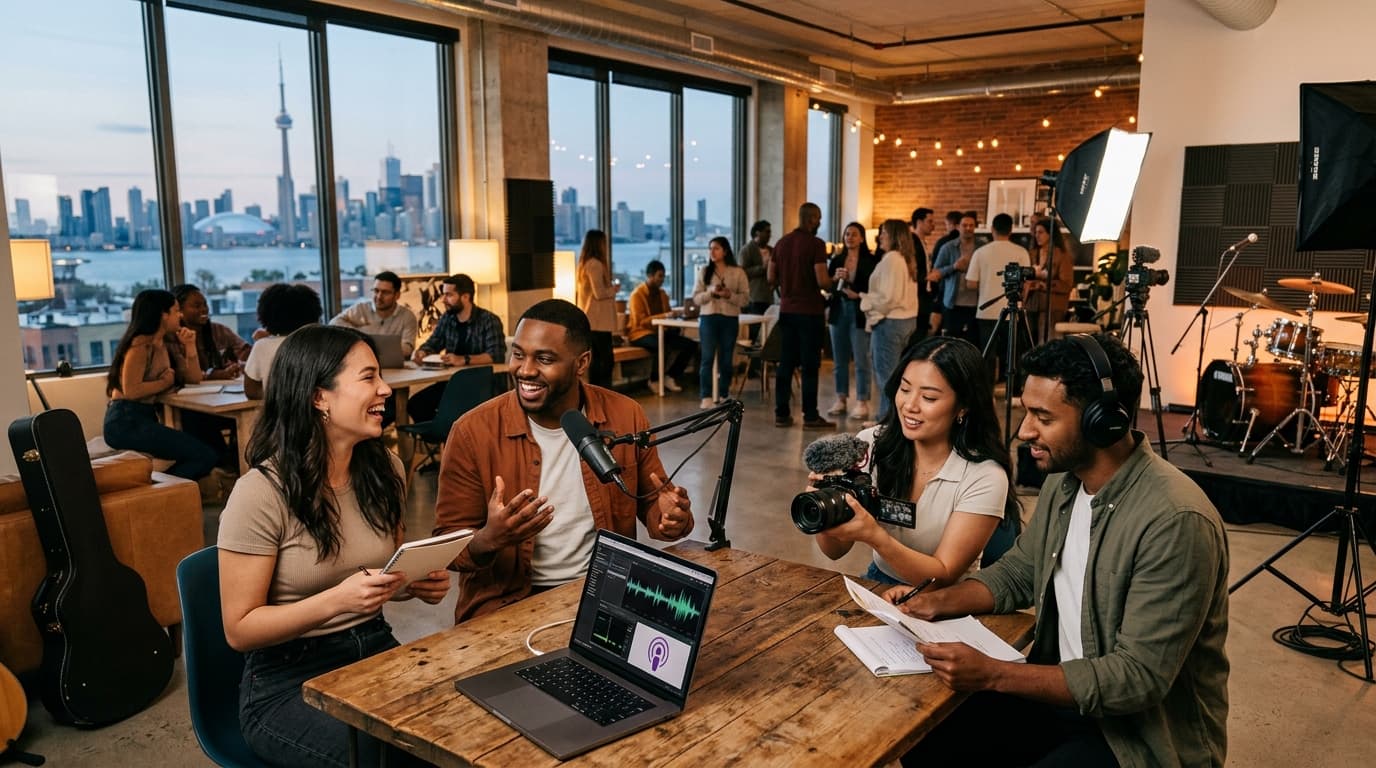
Toronto doesn't have one creator scene. It has about six, loosely connected, mostly ignoring each other. The podcasters in Liberty Village don't know the musicians in Parkdale. The TikTok crowd downtown rarely crosses paths with the actors doing self-tapes in a basement in the Junction. If you're starting out and googling "Toronto creator community," you'll find a lot of dead Facebook groups and one Discord server that peaked in 2022.
Here's a more useful way to think about it: the scene isn't a single event you RSVP to once. It's a handful of physical spots and recurring windows of time where people doing similar work show up, over and over, until they recognize each other. Below is a map of where that actually happens, organized by what you're trying to do and who you'll run into.
Why the Scene Feels Invisible Until It Isn't
Most creator activity in Toronto is low-key by design. Nobody's renting out Roy Thomson Hall for a podcasting meetup. It's twelve people in the back room of a bar on a Tuesday, or a coworking space's community Slack channel that only gets active twice a month. The barrier isn't money, it's knowing which Tuesday.
This matters because a lot of new creators assume the scene lives on Instagram or TikTok. It doesn't. Social platforms are where creators post after they've already made something. The actual collaboration, the "hey can you shoot my demo reel" or "I need a drummer for Saturday" conversations, happen in person, in small rooms, usually unplanned.
Neighborhoods That Function Like Informal Studios
Toronto's creative geography breaks down roughly like this:
Parkdale and the Junction skew musician and visual artist. Rent is still low enough that people have home studios, which means a lot of informal jam sessions and gear-swapping happens through word of mouth rather than official events.
Queen West and Ossington pull in photographers, stylists, and brand-content creators. The density of small boutiques and cafes means there's constant low-level demand for product photography and short-form video, which is a decent entry point if you're building a portfolio.
Liberty Village and King West have the highest concentration of podcasters and business-adjacent creators, partly because the office crowd there already thinks in terms of personal branding and LinkedIn content.
The Annex and around the universities (U of T, TMU) are where you'll find student filmmakers, actors doing scene study, and a rotating cast of people graduating out of film and media programs every April, which is worth noting if you need a crew for a short.
None of this is official. Nobody draws these boundaries on a map. But if you're trying to find, say, a bassist for a three-song demo, you'll have better luck posting in a Parkdale-adjacent group than a Liberty Village one.
Coworking Spaces as Accidental Meeting Points
Coworking spaces in Toronto, places like the Centre for Social Innovation locations, Workhaus, or smaller independent spots, were built for freelancers and startups, not creators specifically. But creators use them anyway, because a desk with decent wifi and other people around beats working alone in an apartment.
The useful thing about these spaces isn't the desk. It's the Slack channel or bulletin board where someone posts "need a voiceover for a 30-second ad" or "looking for a second shooter this weekend." If you join one, don't just show up and put headphones on. Say hello, mention what you do in one sentence, and check the community channel once a week. That's genuinely most of the work.
Open Mics, Demo Nights, and Why Showing Up Twice Matters
Toronto has a long-running tradition of open mic nights at venues like the Tranzac, the Rivoli, and Comedy Bar. These aren't just performance slots. They're where musicians meet sound people, comedians meet video editors who want to cut clips, and everyone trades numbers in the fifteen minutes before last call.
The mistake most new creators make is treating an open mic as a one-time test. Say you're a singer-songwriter and you play a Tuesday slot at a Parkdale bar. You get polite applause, maybe one person compliments your song after. That's not a failed night, that's night one. The people who actually build a network go back the following month, and the one after that. By the third or fourth appearance, the bartender knows your name and the other regulars start asking what you're working on. That's when actual collaboration starts, not from a single great performance but from being a familiar face over 8 to 10 weeks.
The same logic applies to demo nights and pitch events in the tech and startup space, Collision conference season in particular draws a wave of content creators into downtown Toronto every year, mostly shooting coverage and interviews. If you're a video creator looking for subjects, conference season is a two-week window where a lot of people are camera-ready and looking for coverage.
Festival Windows Worth Marking on a Calendar
A few recurring dates structure the Toronto creator year, even if you're not directly participating:
- Canadian Music Week and NXNE (spring/June) pull musicians and music-adjacent creators into a tight few weeks of shows, panels, and informal networking around venues on Queen West and in the Entertainment District.
- TIFF (September) is obviously about film, but the week around it also floods the city with photographers, video editors, and content creators covering red carpets and after-parties, which is a decent, if chaotic, place to meet other working creatives.
- Nuit Blanche (October) turns the whole downtown core into a temporary gallery for one night, and a lot of visual artists and installation creators use it as an unofficial portfolio launch.
None of these require a ticket to benefit from. Walking the perimeter of a festival, talking to the people setting up gear, often gets you further than attending the main event.
Online Groups That Actually Lead Somewhere Offline
Discord servers and Facebook groups for Toronto creators come and go fast. The ones worth your time share two traits: they post specific, dated, in-person meetups (not just "let's connect!" messages), and they have active moderators who show up to those meetups themselves. If a group has 2,000 members but the last event was 14 months ago, treat it as a dead listing. Check the events tab before you join, not after.
A reasonable filter: if a community hasn't organized something in person in the last 60 days, it's a group chat, not a scene.
Where Equipment and Collaboration Collide
Eventually, meeting people leads to needing a room. A musician you met at an open mic wants a proper demo recorded. A podcaster from your coworking space's Slack wants a second mic and an actual acoustic setup instead of a closet with blankets taped to the wall. This is the point where informal hangouts turn into actual production, and it's usually the step new creators underestimate. You can network for months, but at some point someone needs four hours in a room with good mics and no hallway noise.
That's less about finding the scene and more about having somewhere to take what you find there.
A Few Practical Notes for Showing Up
Bring something specific to talk about. "I make content" gets a polite nod. "I'm cutting a 90-second reel for a bakery on Dundas this week" gets a real conversation.
Follow up within 48 hours. A LinkedIn connection or Instagram follow sent two days after meeting someone has a far better response rate than one sent two weeks later, mostly because they still remember your face.
Go to the same spot at least three times before deciding it's not for you. The first visit to any recurring event is mostly just logistics, where to park, who runs the sign-up sheet, what time it actually starts versus what time it's listed. The networking part kicks in on visit two or three.
Closing Thought
The Toronto creator scene in 2026 isn't hiding. It's just spread across a dozen small rooms instead of one big one. Find the room that matches what you make, show up more than once, and bring something specific to say. The gear and the studio time come later, once you know who you're actually making things for.
Your first hour is a dolla. Reserve your session at dollastudio.com